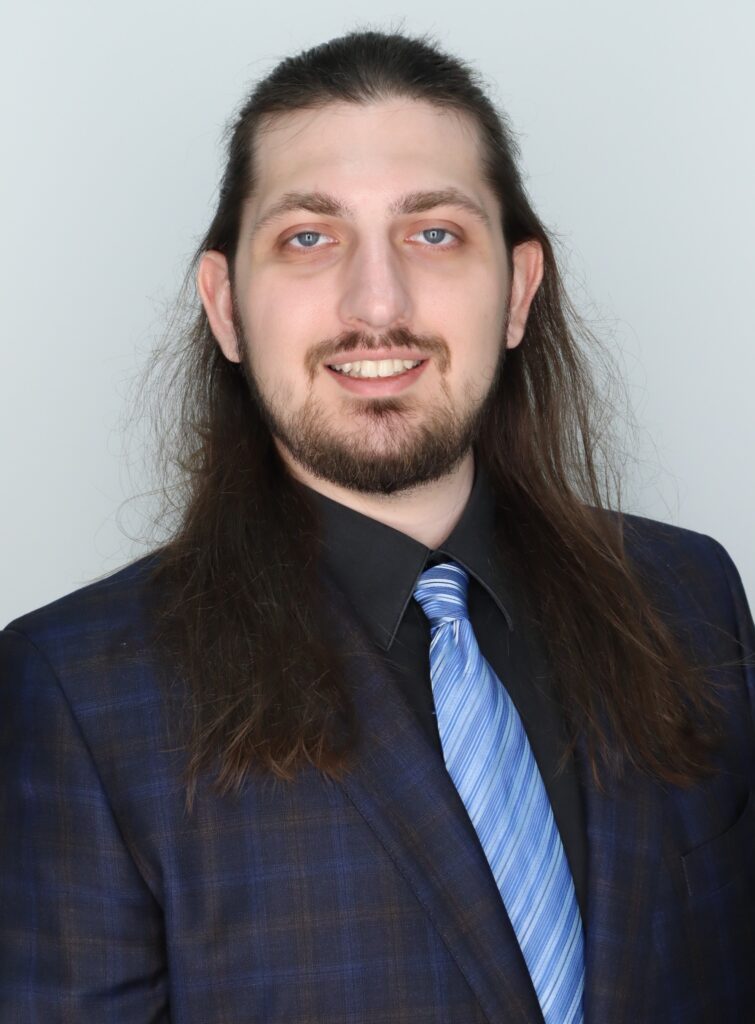
Bachelors in Electrical Engineering
Focus of Computer Architecture and a Minor in Computer Science
(512) 949-9411
slorenzen05@gmail.com
A passion for engineering
My time in college has covered several industry level projects
Machine Learning Model
My Machine Learning for Engineering Applications course includes cluster access so that students develop and train models using Python and deep learning techniques.
Fabrication-Ready Carry-Select Adder
My Very Large Scale Integration course included the development and timing analysis of a CMOS based full adder. The final presentation included an analysis of how optimized the Microwind design for our 8-bit carry-select adder was.
Programming of a Microprocessor
My two-semester Senior Design course featured programming an NXP FRDM board to use various peripherals such as switches, LEDs, sensors, and motors. The goal of the project was to create a lab tool that Texas State students could use to practice programming a microprocessor.
An array of courses
Circuit Analysis and Design
- Use of Verilog, LTSpice, Multisim, and breadboards.
- Covered RLC analysis, filters, operational and multi-stage amplifiers, FPGAs, BJTs, MOSFETs, noise, transience, steady-state solutions, and more.
- Used analysis techniques such as Bode plots, KVL, KCL, mesh analysis, Norton and Thevenin equivalency, superposition, Laplace transformations, and more.
Advanced Physics and Mathematics
- Math topics such as: Calculus 3, Linear Algebra, Differential Equations.
- Physics topics such as: Optics and Thermodynamics, Electricity and Magnetism, Mechanical Physics, Electrical Properties of Materials (semi conductors and solid-state physics), and Quantum Physics.
- Engineering applications such as: Probability Analysis for Random Signals & Systems and Linear time invariant system analysis including Fourier and Laplace transformations
Programming
- Languages: C, C++, Java, and Python
- Programs: VSCode, Verilog, Vitis, NXP Xpresso, and MatLab
- My courses covered file access, memory leaks, object-oriented programming, classes, functions, inheritance, exceptions, pointers, the stack, arrays, lists, run-time optimization, sorting algorithms, UML diagrams and multiple levels of language from pseudo code down to Assembly.
Computer Architecture
- RISC and CISC Architecture, microprocessors, ARM Architecture, and hardware design languages.
- We covered caches, RAM, levels of memory storage. We used hardware deign languages to simulate a arithmetic logic unit while analyzing its RISC architecture and tracking how data flows through its pipeline.
- We practiced in I/O interfacing across SPI, I2C, and UART communication as well as programming functions to use the communication methods.
- We used Hardware Design Languages to implement custom microprocessors and peripheral architectures.
Computer Networks
- Computer Networking Protocols such as HTTP, TCP, and UDP and the binary contents of the messages sent across the network.
- An overview of each of the Physical, Data-Link, Network, Transport, and Application layers of the TCP/IP Reference Model.
Machine Learning
- Wrote models in Python and trained them using a Cluster.
- Covered deep learning techniques such as model characteristics, neural network theory, classifiers for network and signal processing applications, regression and convolutional modeling for object-detection, time-series and forecasting machine learning models for Smart City concepts.
Engineering Design
- Teamwork, PACE Development, product specifications, weekly reports, design and development documentation, test benches, and oral presentations to industry professionals.